
Some nights I dread tomorrow's dressing change. Other nights it's an old, familiar voice asking why you can't just handle this better, and that voice usually turns out to be much older than the wound.
That's often when people start reading about IFS therapy. Exploring who IFS therapy is for and who it may not suit can help you determine whether this approach fits your needs. It tends to suit people who feel torn inside, live with a harsh inner critic, or still react to today the way they learned to as kids. During a crisis, active psychosis, or early recovery from substance use, it may not be the right first step. The signs below can help you work out which side of that line you're on.
TL;DR Quick Answers
Who Is IFS Therapy For? (And Who It May Not Suit)
IFS therapy is for people who already understand their patterns but can't change them, often because a protective part keeps stepping in. It may not suit someone in crisis, experiencing psychosis, or early in substance use recovery. For them, "not yet" is the honest answer, not "never."
Often a good fit if you:
Feel torn inside, with one part wanting change and another resisting it
Know why you do something and still can't stop
Live with a harsh inner critic or perfectionism
Fall back into childhood reactions in adult moments
Tried talk therapy and the core never moved
May not suit you yet if you:
Are in crisis or unsure you're safe (call or text 988 first)
Are experiencing psychosis or paranoia
Are in early substance use recovery
Want structured skills and homework (CBT or DBT may fit better)
Mainly struggle within one relationship (couples or family therapy may help more)
Top Takeaways
IFS tends to suit people who feel torn inside, stuck despite insight, or ruled by a harsh inner critic.
Childhood reactions that keep surfacing in adult life are one of the strongest signs parts work may help.
A crisis, psychosis, or early substance use recovery usually calls for a different first step.
The evidence is promising but young, and the IFS Institute itself says the field needs larger trials.
If two or more signs fit, a free consultation is a low-risk way to find out.
What Is IFS Therapy, in Plain Words?
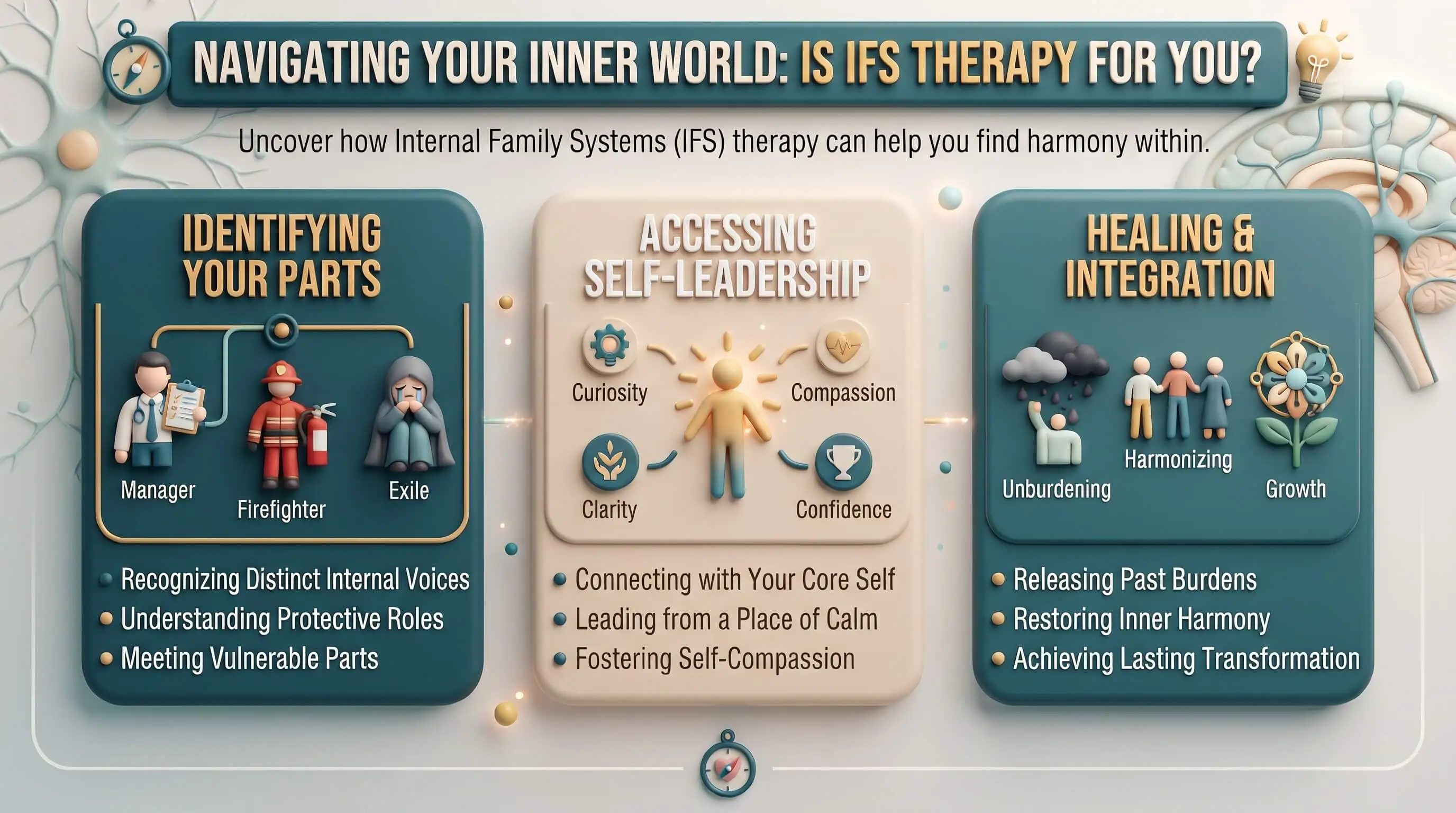
Psychologist Richard Schwartz built Internal Family Systems around a simple idea. Your mind works less like a single voice and more like a household, where different parts each hold a job.
Some of those parts took on protective roles early in life. They plan, push, criticize, or go numb so you don't get hurt the same way twice. Other parts hold the older hurt the protectors are guarding. Underneath all of it sits what IFS calls Self, the calm and curious center of you that's still there on bad days.
Rather than getting rid of any part, the work aims to know each one well enough that it can finally ease up.
You don't have to love the labels, by the way. Plenty of people find them helpful, and plenty of others ignore them and do the work anyway.
Who Is IFS Therapy For? (And Who It May Not Suit)
No article can make this call for you. Still, a handful of patterns come up again and again in people who do well with IFS, and they're worth checking yourself against.
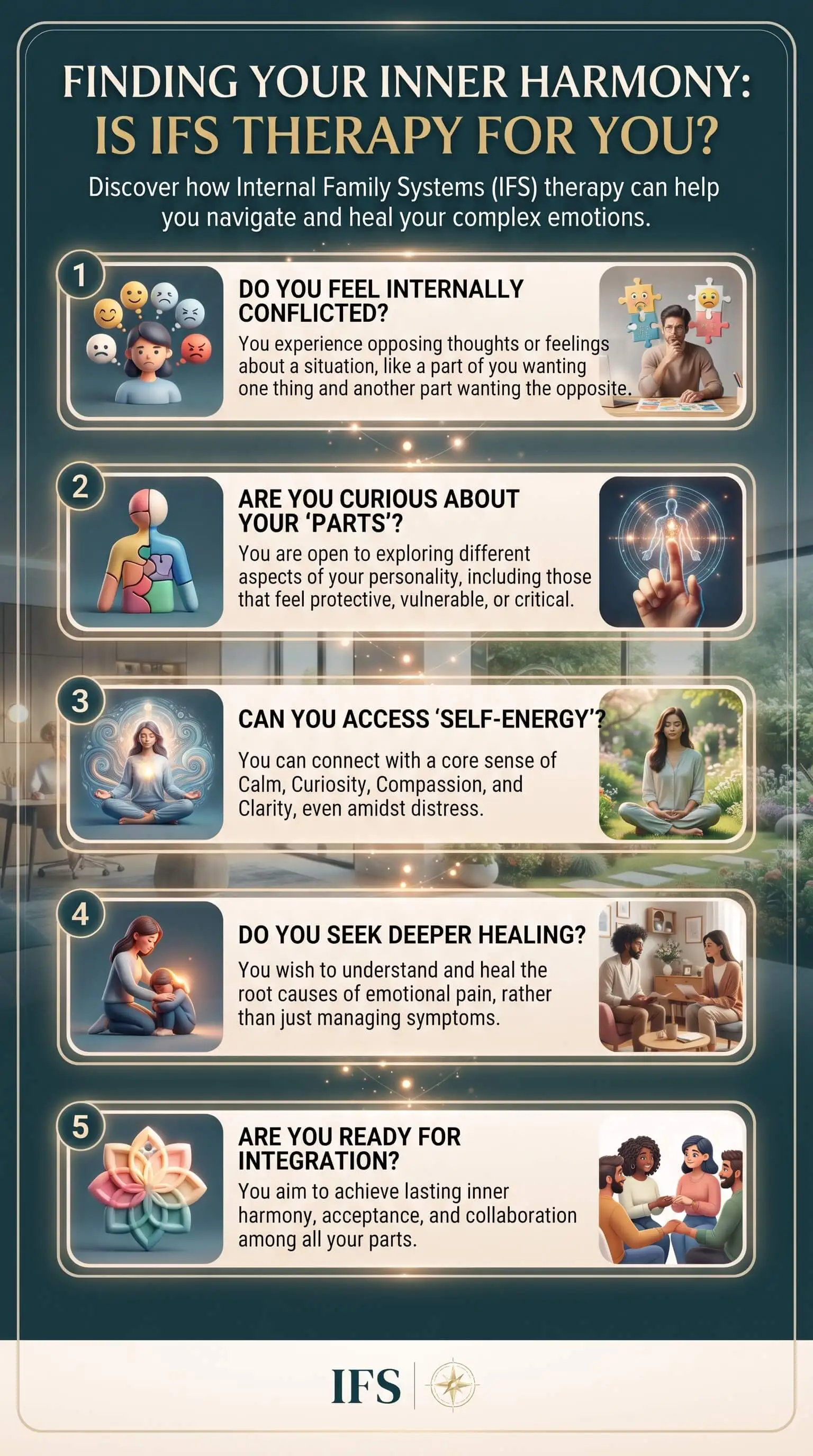
Sign 1: You Feel Pulled in Different Directions Inside
If one part of you wants change and another keeps digging in its heels, IFS speaks your language. You want to rest, and something says you haven't earned it yet. You want to ask for help, and another voice calls that weak. IFS treats each pull as a part with its own reasons, which is a lot kinder than deciding you're the problem.
Sign 2: You Understand Your Patterns but Can't Change Them
Knowing why you do something rarely stops you from doing it. You can name the pattern and trace it back to where it started. You still snap, shut down, or say yes when you meant no. Plenty of people get stuck in that gap between knowing and changing, and IFS works right there, with the parts running the pattern, instead of asking you to think your way out.
Sign 3: Your Inner Critic Never Lets Up
That harsh inner voice is usually a protector doing a job it took on years ago. Being hard on yourself probably kept you safe at some point, whether from mistakes or from someone else's criticism. Arguing with it tends to make it louder. Once you get curious about what it's afraid of, it often softens, and perfectionism usually responds the same way.
Sign 4: Old Childhood Reactions Show Up in Adult Life
Your past doesn't need one dramatic event to still be running the show. Sometimes it's years of feeling unseen, or growing up in a home where you learned early to keep the peace. Then someone uses a clipped tone, or a text goes unanswered, and you're eight again. IFS does especially well with those younger parts and whatever they're still carrying.
Sign 5: Talk Therapy Helped, but Something Still Feels Stuck
If you've done therapy before and the core never moved, a different approach may get further. IFS is experiential. You spend much of a session noticing and connecting with parts rather than only talking about them, and for people who feel more than they can put into words, that shift matters. Lauren Rath's guide to who IFS therapy is best for goes deeper on each of these patterns and on what a session looks like.
If you recognize yourself in two or more of these, IFS is worth a conversation.
When IFS May Not Be the Right Starting Point
Deep work needs solid ground under it. IFS may not be the best first step if any of these fit you:
You're in crisis or unsure you're safe. Get immediate support first by calling or texting 988 in the U.S.
You're experiencing psychosis or paranoia. Talk of "parts" can muddy things here, so specialist psychiatric care is the better place to begin.
You're early in recovery from substance use. A recovery-focused program can help you get steady before parts work.
You'd rather have clear structure and homework. Skills-based approaches like CBT or DBT may suit you better, at least at the start.
If the hardest part of your life sits between you and a partner or parent, couples or family therapy may do more than individual work can.
None of this is a permanent no. Plenty of people find their way to IFS later, once things feel steadier.
What Does the Research Say About IFS?
The research looks promising and is still young. The IFS Institute's research summary lists the studies so far. In 2013, the Journal of Rheumatology published a randomized trial in people with rheumatoid arthritis that reported less pain and fewer depressive symptoms, along with better physical function and self-compassion. A 2016 pilot trial looked at depression in female college students. More recently, researchers have tested online group IFS programs for PTSD.
The Institute says plainly that the field still needs larger trials. I find that candor reassuring, because it lets you walk in with realistic expectations instead of a sales pitch.
"The people who do well in IFS are rarely short on insight. Most of them can tell me exactly why they're stuck, sometimes in more detail than a textbook would. What I keep seeing is that the part holding them there is trying to help. A harsh inner critic usually started out as protection, and once we stop arguing with it and get curious about what it's afraid of, it tends to ease up on its own. When someone needs safety or structure first, I'd rather tell them that plainly and point them somewhere good."
7 Essential Resources
1. Read the Model From the People Who Built It
The Internal Family Systems Model Outline (IFS Institute) walks through the model's core assumptions, from parts and Self to how the work unfolds. Start here if you'd like the framework straight from the source.
2. Know What to Ask Before You Book
The APA's guide on how to choose a psychologist covers how to vet a licensed therapist, plus the less fun part about costs and insurance. You'll get used to it whether or not you end up in IFS.
3. Talk to Someone Before You Decide
If you're not sure where to begin, the NAMI HelpLine is a good first call. Its staff and volunteers offer free information and referrals to people living with a mental health condition and the families around them.
4. Get Help Right Away if You're Not Safe
The 988 Suicide and Crisis Lifeline answers calls, texts, and chats around the clock at no cost. If you're in crisis, start here, well before any deeper therapy.
5. Find Licensed Care Near You
SAMHSA's FindTreatment.gov searches state-licensed treatment for mental health and substance use across the U.S. It's especially handy if you need a recovery program before parts work makes sense.
6. See How IFS Compares for Trauma
The VA National Center for PTSD's PTSD Treatment Basics lays out the main trauma options, from trauma-focused talk therapies to medication and complementary approaches. Think of it as a map that shows where IFS sits among them.
7. Get a Balanced Outside View
Psychology Today's overview of Internal Family Systems Therapy explains the model in plain terms and is candid about who may not be a good candidate. It also links to a directory of IFS-trained therapists.
3 Statistics
1. Most Adults Carry Something From Childhood
The CDC reports that 61% of U.S. adults had at least one adverse childhood experience, and 16% had four or more types. If Sign 4 hits close to home, you're in the majority. Source: CDC Vital Signs: Adverse Childhood Experiences
2. Nearly One in Four Adults Lives With a Mental Illness
In 2022, an estimated 59.3 million U.S. adults, or 23.1%, had any mental illness. That's a lot of people quietly carrying something. Source: National Institute of Mental Health: Mental Illness Statistics
3. Only About Half Get Treatment
Of those 59.3 million adults, 30 million (50.6%) received mental health treatment in the past year. The rest didn't, for every reason you can think of. An approach that fits you can make starting feel a little less daunting. Source: National Institute of Mental Health: Mental Illness Statistics
Research shows that childhood adversity and mental health challenges affect millions of U.S. adults, yet only about half of those with mental illness receive treatment. Healthcare professionals play an important role in helping individuals recognize emotional struggles, explore suitable therapy options, and access appropriate mental health support.
Final Thoughts and Opinion
Here's where I land. IFS earns its popularity for a specific kind of person. If you already know your inner critic, your people-pleaser, and the part of you that shuts down when things get loud, and you're simply tired of them steering, IFS offers something many approaches skip. You get to work with those parts instead of fighting them.
Where I'd push back is on the idea that it suits everyone. Someone in crisis needs safety before anything else. Someone who thrives on worksheets may get further, and faster, with CBT or DBT. Saying "not yet" to IFS is a perfectly good answer, and it isn't the same as saying "never."
The research is encouraging and still catching up. With IFS therapy explained in more detail, go in curious rather than sold, and let a short consult tell you more than any article can, this one included.
Frequently Asked Questions
How do I know if IFS therapy is right for me?
Look at your patterns before you worry about labels. IFS is worth exploring with a trained therapist if two or more of these sound familiar: feeling pulled in two directions, understanding your habits without being able to shift them, living with a critic that never clocks out, or catching childhood reactions in adult moments.
Who should not do IFS therapy?
IFS usually isn't the right first step for someone in crisis, someone experiencing psychosis or paranoia, or someone in early substance use recovery. People who want structured skills practice may do better starting with CBT or DBT. Many of them come back to IFS later, once life feels steadier.
Is IFS therapy evidence-based?
IFS has a growing research base, including randomized trials in rheumatoid arthritis and depression plus newer PTSD studies. The IFS Institute openly says the field needs larger trials. Promising but young is the fairest summary.
Do I have to believe I have "parts" for IFS to work?
No. Most people walk in skeptical, and that's welcome. You don't have to buy the vocabulary. You only need to be willing to notice what comes up, whether that's a feeling or a tightness in your chest, and stay a little curious about it.
Can IFS therapy help with the stress of a long illness or recovery?
It may. A long recovery tends to stir up fear and a good deal of self-blame, especially when treatments like negative pressure wound therapy are involved. IFS can help you understand the parts reacting to all of that and meet them with more patience. It works alongside your medical care and never replaces it.
Does online IFS therapy work as well as in person?
For many people, yes. IFS relies on noticing what's happening inside you, so it carries over well to video. Some people find it easier to turn inward from their own couch. A consult is a simple way to see how it feels for you.
Take the Next Step
If a few of those signs sounded uncomfortably familiar, that's worth listening to. Book a free 15-minute consultation with an IFS-trained therapist and bring every question you've got. There's no pressure and no commitment on either side, so reach out whenever you're ready. And if you're in crisis right now, please call or text 988 first.


